
Dear supporter,
It’s a mixed bag this time. Not good news, I’m afraid, on the ‘honesty in politics’ front, but it’s not all bad, sad or mad. We battle on…
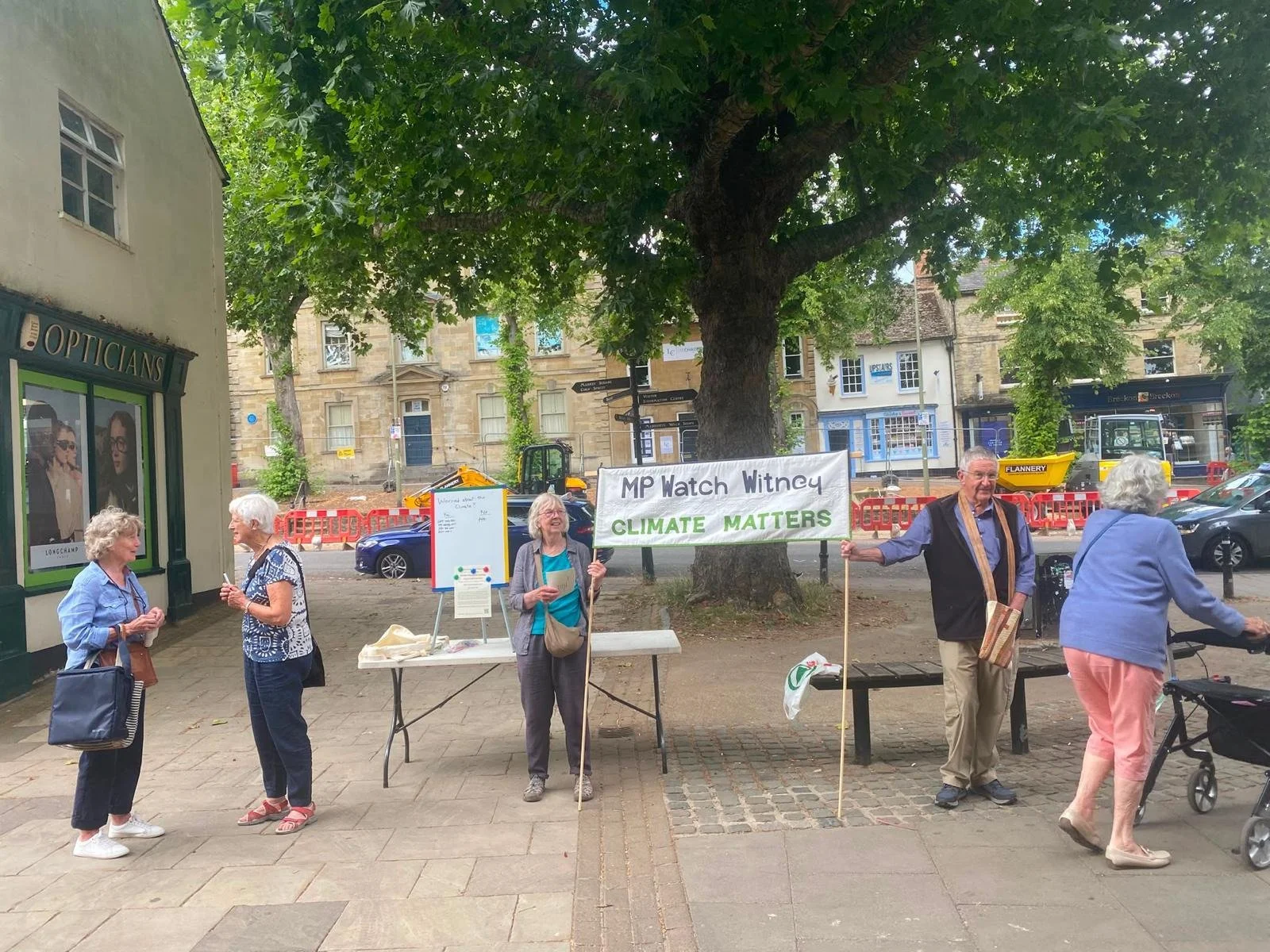
And, just so you know, we have been back on the pavements of Witney…
The good news first: Witney Eco Forum and MP Watch Witney jointly hosted a highly successful People’s Emergency Briefing screening, followed by an hour of facilitated discussion, last Thursday evening, July 16th. The film is a popularised and shortened version of the National Emergency Briefing day in Westminster last November. At that fuller briefing, nine experts gave TED type talks on nine aspects of climate change.
It’s very well worth viewing these alarming and informative talks and they may be seen individually on www.nebriefing.org.
At this point we need to thank the dogged and indefatigable Kate Banks of Witney Eco Forum for her very considerable work in enabling our screening. She’s a real star!
We showed the film in St Mary’s Church, Witney. Some 160 very engaged people attended and there was good, intelligent audience participation, various and vigorous, which helped take the discussion into some fruitful places. We had the strong impression that not everyone who came was already one of the ‘converted’ - indeed several specifically told us they had been during the evening. A few came up to speak to us, seeking advice into doing screenings elsewhere, and some were opting to follow our broad guidance about local groups already acting on climate or environment.
There was considerable shock in the room during and after the screening, and considerable education and resolve was obviously happening, and was reported by the audience. The film really works, delivering necessary punch but some optimism too. Charlie Maynard, MP for Witney, came and Hugo introduced him as an MP who had attended the NE Briefing, to enthusiastic applause. Andrew Prosser, climate lead at WODC, also came and was able materially to help the discussion.
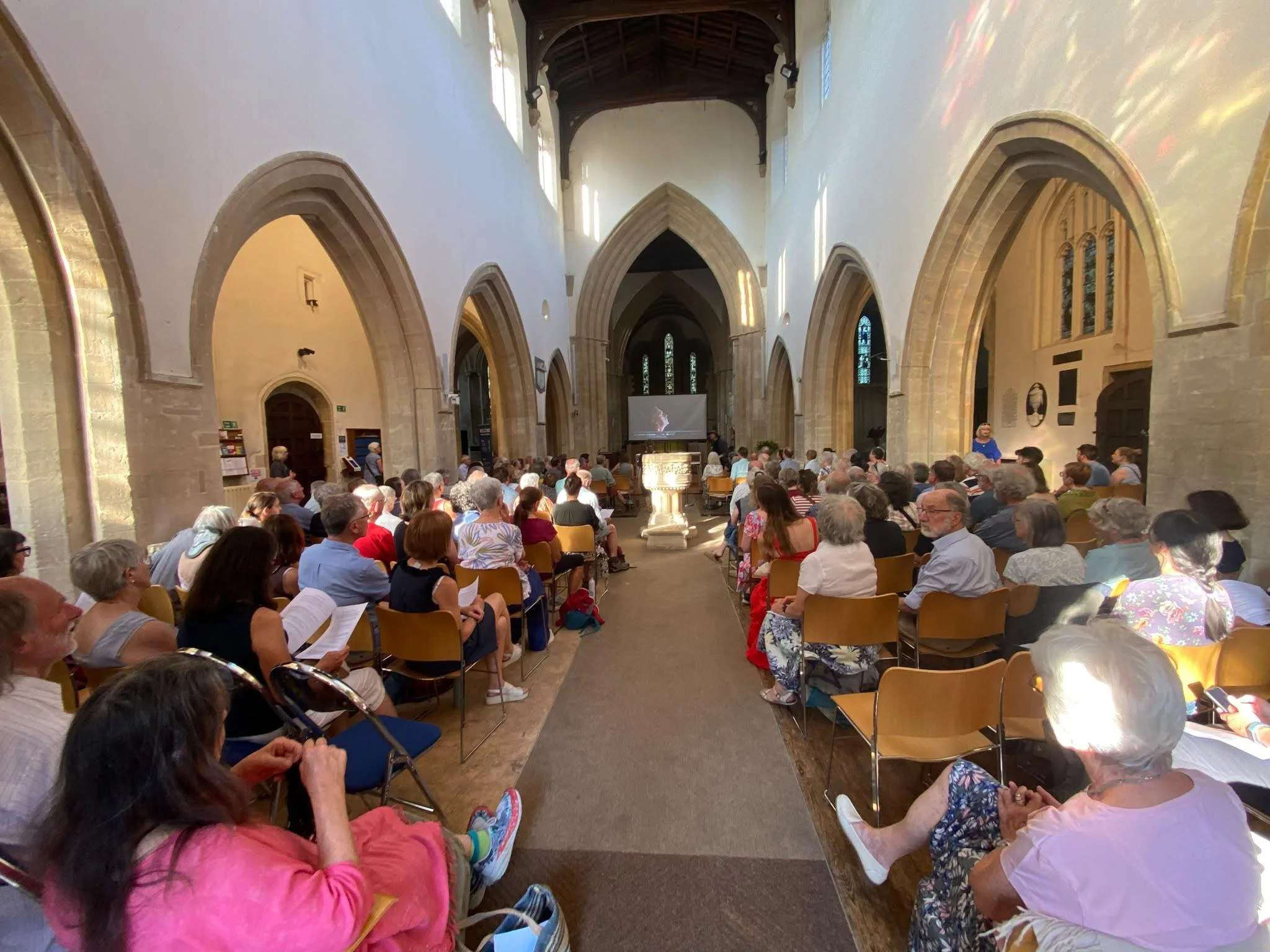
The church was packed when we screened the People’s Emergency Briefing
That was Thursday evening, which was followed by our long-booked Climate Matters Meeting with Charlie the very next Saturday. This was our seventh such meeting. Although we are normally focussed exclusively on climate change and Thames Water is not a climate issue, we asked Charlie (because he’s the horse’s mouth when it comes to Thames Water) to begin with an update. He pointed out that Andy Burnham has been suggesting that public ownership in some form is being considered and that taking it into administration, as we must, may finally happen. It’s a wait-and-see situation, and our autumn meeting is on October 24th, when we may know more.
Then we moved on to honesty in politics. Admittedly this is a bee in our bonnet, but it is a large and existentially important bee. Let us explain…
As our previous readers will already know, the Welsh Senedd has very recently passed legislation outlawing ‘deliberate deception’ by Senedd members or candidates. In Wales, in other words, it is now illegal for politicians deliberately to mislead the public. This seems fundamental to our cause.
The ‘Hillsborough Law’ (The Public Office (Accountability) Bill) has passed through the Commons and reached the Lords, where it could still be amended. The Bill makes it an offence for a ‘public official’ to mislead the public but as it presently stands this does not include an MP below the level of a Minister of the Crown.
An amendment to the Bill to address this was tabled by a Labour MP, Luke Myer, in the previous parliament. His amendment sought to make it illegal for all parliamentarians to deliberately mislead. When that parliamentary session ended, though, the amendment fell, as the Bill ran out of time.
The Bill was therefore reintroduced in the King’s speech to the present parliamentary session without the amendment. Very oddly, Myer didn’t table his amendment again and it has now reached the Lords without the requirement that all MPs desist from misleading us.
If the Lords do not table, and pass, the Meyer amendment or similar, the case is lost, as the Commons cannot introduce new amendments when they next see the Bill. (They can only debate amendments the Lords may have inserted.) The Lords are also in recess, as we write, but the Bill is to be debated in the upper chamber when they return in early September.
Hugo made a passionate case for reintroducing a Myer type amendment into the Bill in the Lords, but Charlie poured a fair amount of cold, practical water onto that.
He pointed out that there’s a strong Tory majority in the Lords and that they would probably vote against. But as Charlie also pointed out, Luke Myer didn’t table his own amendment again. Charlie’s view, therefore, was that the senior Labour Party had probably decided they wouldn’t support it. In other words, Charlie doesn’t see it being tabled, or succeeding if it was.
Hugo pushed on, saying that this was a quintessentially Lib Dem kind of policy which would be electorally popular and which was existentially necessary if the climate cause was not to founder under a torrent of increasingly wild, high-level disinformation. Charlie agreed wholeheartedly with the premiss and conclusions and made that loudly clear, and he agreed, when asked directly, to write to his party leader about making a case in the Lords but was not optimistic that the amendment could be resurrected.
So, Charlie’s intelligently presented and informed view was that a Myer type amendment is worth pursuing but is unlikely to pass.
We think this may be a pivotal, history-changing loss which won’t be recoverable. There were about 40 people at the meeting, and they were mostly very visibly disappointed. Charlie was not in doubt about that. He’s promised to report back to Hugo on actions and progress.
So there we probably are. It’s not clear whether we can do much more except look enviously across Offa’s Dyke. There is still a faint hope and a little time, so we have written to a couple of members of the Lords who both spoke strongly in favour last session to urge action in this one.
They are Baroness Jones of Moulsecoomb (Green), and Lord Knight of Weymouth (Labour). If you are as concerned about truth in politics as we are, perhaps you will write to these two and ask that they table, and urge, the Meyer amendment. Their email addresses are jonesjb@parliament.uk and knightja@parliament.uk.
In the meantime, Charlie will urge his leadership to ask Lib Dem peers to seek to table the amendment and argue for it.
We always take August off, so we all hope you will enjoy a cheerful summer in peace. The Met Office, in their report on 2025, claims that our reliably unreliable old weather “has gone” so we hope enough of it remains for you, and us, to do that.
Democracy is not a given, it is a process which must be fought for continually by people of public spirit and good hearts. Our supporters are such people and we’re grateful.
Hope to see you at 11 am in the Winchester room in St Mary’s church on October 24th for our autumn Climate Matters Meeting with Charlie.
In the meantime, have a happy summer,
Very best wishes,
All at MP Watch Witney